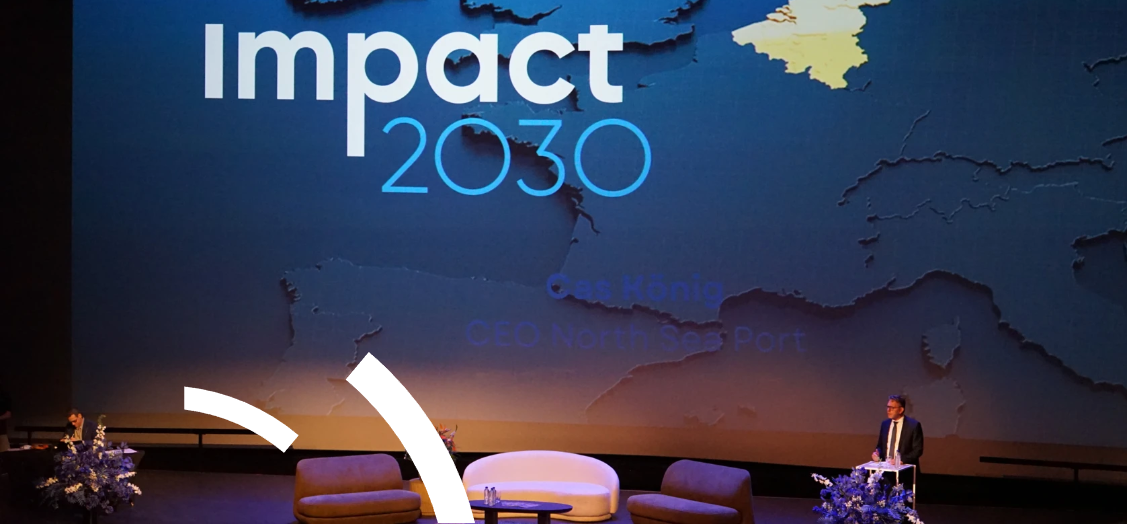
North Sea Port will further develop its position as a leading European port in the coming years by investing in the required port infrastructure, spatial development and solid logistics chains. The port authority will be focusing more strongly on enhancing security and resilience, as well as the port's immediate living environment. Under the title ‘Impact 2030’, the new strategic plan was announced at the North Sea Port Conference on Monday, 17 November.
In its new strategic plan, North Sea Port commits itself to targeted growth, sustainability and connection with the local area. This is why the plan has been given the title 'Impact 2030'. The central question it answers is: How do we ensure that, together, we continue to grow sustainably, make an impact and add value for a resilient economy and society in Europe, today and tomorrow? And, how do we do so regionally, in the Netherlands, Flanders, Belgium and Europe?
The plan sets out how North Sea Port will continue its development as a cross-border Dutch-Flemish port for the next five years, with a look ahead to 2035. The plan builds on the previous strategic plan, Connect 2025, and addresses the challenges of today and tomorrow. The strategy also reflects the mission of the eight public Dutch and Flemish shareholders: to strike a balance in value creation between economic development, sustainability and financial performance. The shareholders also highlight the important prerequisites of a safe port area and the quality of the living environment.
Sustainable targeted growth and adding value in five domains
The core of this strategic plan is how North Sea Port can grow sustainably and purposefully with impact and continue to add value economically, ecologically and socially. To this end, the port authority has defined its strategic direction in five key areas of action.
1. Top European port for customers with sustainable ambitions in manufacturing and processing industries and related logistics: by anchoring companies in the port, and facilitating the energy and raw materials transition.
2. Increasing resilience and investing in the security of the port and its surroundings: through intensive cooperation with companies, authorities and other ports and local stakeholders, delivering physical and digital safety and security measures, resisting organised crime, assuring the safety of the environment and the local area, supporting military transport.
3. Making space for targeted growth, consistent with the aims of the raw material transition, energy transition and sustainable multimodal logistics: prioritising the development and infill of sites within the port area for port and water-related activities, and acquiring and developing sufficient space to enable the growth of port and water-related businesses.
4. Achieving and accelerating the implementation of smart and sustainable port infrastructure: North Sea Port remains a crucial hub within the European transport network; working on (cross-border) infrastructure for hydrogen, CO2, rail and road transport and bicycle traffic, and optimising the Ghent-Terneuzen Canal to reap the full economic benefits of the New Lock.
5. Strengthening North Sea Port's coordinating role to achieve effective and sustainable logistics chain connections: by delivering the North Sea Portal digital platform, expanding the number of open intermodal connections for companies via deep sea, short sea, inland navigation, pipeline and rail, creating new truck parking areas and promoting sustainable transport from the port via European hinterland connections and outside Europe.
A changing world
The course North Sea Port is now setting is strongly influenced by several external and geopolitical developments. To this end, they drew on research conducted by port economists from Ghent University and Erasmus UPT, who were commissioned by North Sea Port to analyse the most significant developments affecting ports. The developments that will define the future are: the energy and resource transition and climate adaptation, geopolitical tensions(wars, economic sanctions, trade conflicts), the position of (European) industry, the security situation within society and organised crime, technological progress and pressure on (available) space. This makes ports like ours in the Netherlands and Flanders crucial for the economy, for the security of supply of raw materials, energy and food, and for resilience.
Cas König, CEO North Sea Port: "With this strategic plan, we are creating a solid foundation for targeted, sustainable growth of industry in our cross-border port area, while ensuring a good balance with the local environment. Industry is currently under pressure, and with it our earning power and prosperity in the Netherlands and Flanders. We therefore call on our partners and government: let us together strengthen and - above all - accelerate the implementation of these impactful initiatives for port, industry and environment."
Image: North Sea Port