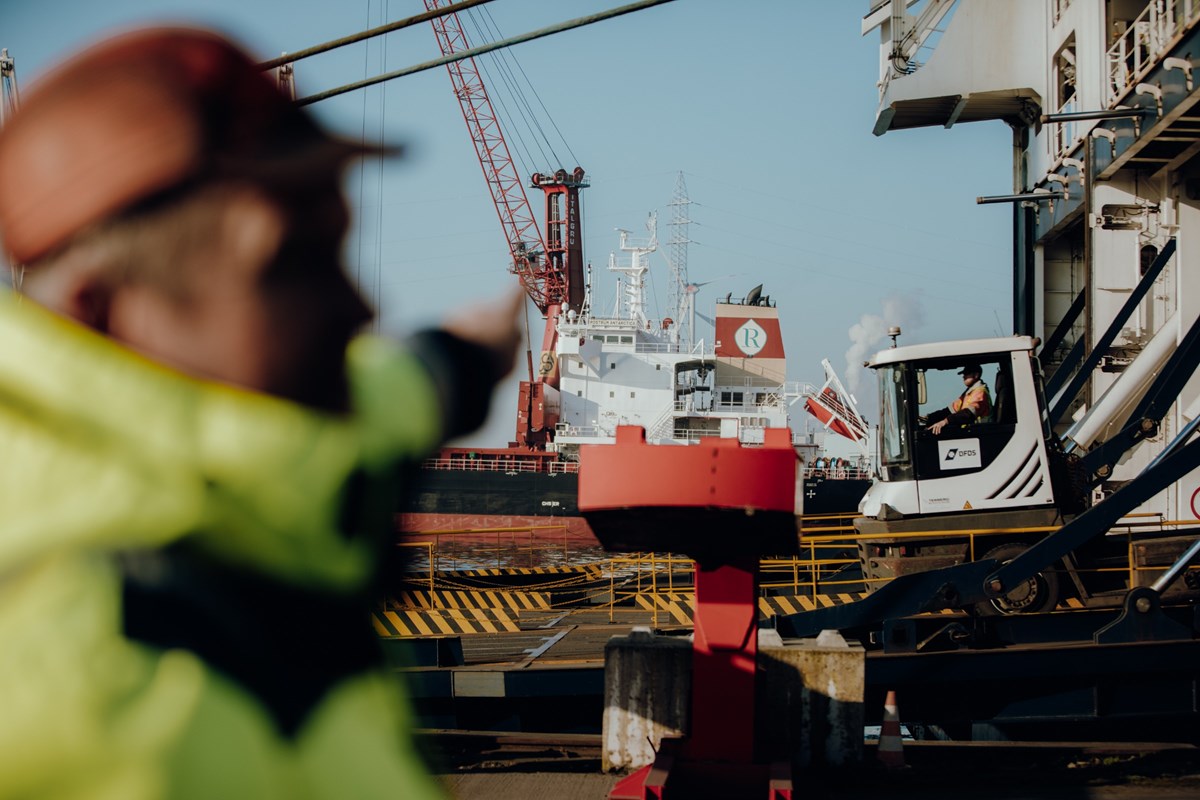
In the first half of this year, companies in North Sea Port handled 33.2 million tonnes of seaborne cargo transhipment. Although there was a slight decline of 1.2%, the transhipment of dry and liquid bulk continues to perform strongly. The decline is in general cargo and roll-on/roll-off traffic.
Thanks to the diversification of activities and types of goods in North Sea Port, cargo transhipment remained more or less unchanged during the first six months. In total, 0.4 million tonnes less (-1.2%) were transhipped by sea than in the same period in 2024. It is noteworthy that transhipment in the second quarter was exactly the same.
With growth remaining unchanged, Great Britain is still the most important trading partner, as was the case (for the first time) in 2024. We notice that Brexit is increasingly becoming a thing of the past. The United States takes second place. With an 8% growth, negative signs of a possible trade war between Europe and the USA are not yet visible in these figures. As a result of increasing EU sanctions, trade with Russia continues to decline during the first half of the year (-14%).
Dry bulk and liquid bulk keep pace
North Sea Port is a true bulk port. Dry bulk accounts for about half of seaborne transhipment, liquid bulk for a quarter. Transhipment of both types of goods remained at the same level compared to the first half of last year: dry bulk goods (such as iron ore, coal, sand, gravel) amounted to 17.9 million tonnes, liquid bulk goods (such as propane, naphtha) to 7.5 million tonnes.
Container transhipment climbed to 98,000 TEU (+ 27,000 TEU, +38.3%). Expressed in weight, this amounts to 930,000 tonnes (+ 180,000 tonnes, +23.5%).
The slight decline in goods transhipment is attributable to general cargo and RoRo. General cargo transhipment fell to 5.0 million tonnes (-0.4 million tonnes, -7.5%), partly due to a shift towards transporting fruit in containers rather than as general cargo (pallets). Roll-on/roll-off (Ro/Ro) fell to 1.9 million tonnes (-0.04 million tonnes, -1.9%).
Inland shipping declines
Transhipment via inland shipping fell to 30.3 million tonnes in the first half of 2025. This is 1.9 million tonnes less (-5.9%) than in the same period in 2024. This decline is mainly attributable to dry bulk: a decrease in trade in sand and gravel, ores and minerals.
Image: North Sea Port