A new study commissioned by Voka, Port of Antwerp-Bruges and North Sea Port shows that the Flemish industry is missing out on hundreds of millions of euros in climate funds every year; funds that could be used in the industrial climate transition, in which the ports play a crucial role.
The study was carried out by Ortelius, the economic consultancy branch of the Econopolis Group, commissioned by Voka (het Vlaams netwerk van ondernemingen) Nationaal and the Voka Chambers of Commerce Antwerpen-Waasland, Oost-Vlaanderen en West-Vlaanderen, Port of Antwerp-Bruges and North Sea Port, in collaboration with BASF Antwerp and Smart Delta Resources Flanders.
After all, one of North Sea Port's priorities as a European seaport is to make the port and industry more sustainable. To achieve this, cooperation with nearby ports and industry clusters in Belgium, the Netherlands and Germany is indispensable.
European climate funds
The study shows that Belgium today receives too small a share of the European ETS (Emissions Trading System) climate funds, and in addition, Flanders receives too small a share of the Belgian share. On top of that, within Flanders, only part of those funds are spent on industry. This implies that overall, the Flemish industry will miss out on €450 to €700 million annually. Both at the European level - the ETS system will be reviewed next year - and within Belgium and Flanders adjustments are needed so that Belgium, Flanders and in particular the industry can become greener and more sustainable. Using a larger share of this revenue to make the industry more sustainable will allow companies to continue investing in green technologies to realise the climate transition.
CO2 infrastructure
The study also shows the need for urgent development of CO2 infrastructure. A national backbone needs to be rolled out at an accelerated pace to enable industry to capture and store CO2 cost-effectively (CCS). The ports play a crucial role here: the construction of CCS infrastructure in the Flemish ports is the foundation of a network of CO2 pipelines across the whole of Belgium. However, the business case only becomes interesting if energy-intensive industries in Wallonia and later the Netherlands and the Ruhr region can also link up to it.
"The ARRRA cluster - the industrial axis Antwerp-Rotterdam-Rhine-Ruhr - is one of the strongest industrial ecosystems in Europe. This study clearly shows where structural corrections are needed to anchor this strategic network and prepare it for a sustainable future. To this end, we provide policymakers with concrete recommendations for further constructive cooperation," said Jacques Vandermeiren, CEO of Port of Antwerp-Bruges.
Hydrogen
North Sea Port also advocates the creation of hydrogen infrastructure, as part of its ambition to achieve a climate-neutral port by 2050, as in the port, CO2 infrastructure and hydrogen infrastructure go side by side. CO2 infrastructure admittedly deserves priority today based on current advanced CCS projects. As market demand expands, hydrogen networks can be expanded.
‘Ports have a good overview of market demand and can signal when public intervention or expansion becomes necessary,’ he said. Simultaneous research into the roll-out of CO2 and hydrogen networks can even be cost-efficient in this respect," said Maarten den Dekker, Chief Sustainability and Digital Officer of North Sea Port.
Read more about the results of the study here.
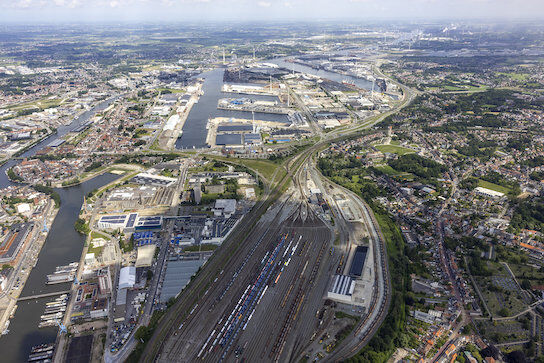
Image: North Sea Port