

Hillebrand and ASK Romein joined forces last year. We spoke to Harm Wattel, Hillebrand’s Business Unit Director, about the merger with ASK Romein and the company’s ambitious plans.
Harm Wattel, Business Unit Director of Hillebrand
A lot has happened recently for Middelburg-based construction company Hillebrand. The former owner of the company left the organisation in 2013 and was, at that time, already looking to sell. Several parties came into the picture. Hillebrand was looking for a financially strong partner that could invest in the enterprise and give it a new impulse. ASK Romein brought not just those features to the table, but also showed considerable synergy when it came to the particular building business they were interested in: offshore and infrastructural projects, which are Hillebrand’s main areas of expertise.
A high-strength merger
ASK Romein was already a big player in offshore and building-industry steel constructions, with an offshore site in Vlissingen and big steel plants in Roosendaal and Malle. They deal with huge quantities of steel and are involved in an impressive array of projects. From offshore to big data-centres, whose construction requires more than 10,000t of steel, to football stadiums and even an indoor ski slope. “That ski slope was built on a landfill,” Mr Wattel explains. “If some old fridge beneath it caved in, the whole steel construction could start giving way. ASK Romein built in a jack-screw construction, which allows every column of the slope to be adjusted separately in height. Any irregularity can be corrected. And we don’t just deliver the steel construction; we deliver turnkey service. The concrete, the steel construction, the siding; everything – right up to the bathroom light switches.”
Hillebrand, on the other hand, had qualities which were of great interest to ASK Romein. Hillebrand specialises in high-strength steel, which is in great demand in the offshore industry and requires specific procedures and experience. With the crisis leaving the offshore sector in a bit of a dip, ASK Romein was looking for a partner that specialised in particular fields. Hillebrand had a 50/50 distribution between infrastructural projects, such as bridges, and offshore. There are many similarities between bridge-building and offshore-building: a bridge is a one-off construction; strict requirements must be conformed to; assembly is often done from the water and design is an essential element. All these factors apply equally to offshore constructions. The two markets are compatible, which was interesting to ASK Romein, who wanted to expand their expertise. The locations of both companies also fit together perfectly: ASK Romein has an open-water location in the port of Vlissingen, which has a direct connection, by water, to Hillebrand’s site in Middelburg. Hillebrand employs an extended on-location (offshore) crew; a specialised workforce equipped with a mobile workshop, which can carry out construction services in any port in Europe. This flexible service was another attractive feature for ASK Romein, guaranteeing full independence from location restrictions. Designing, engineering and procurement often take a long time. Construction then needs to be executed as quickly as possible.
The big advantage of the merger is having several locations that facilitate both infrastructure and offshore construction. Hillebrand, the name now used for both the Vlissingen and Middelburg locations, is therefore able to produce massive offshore projects at both sites in Zeeland simultaneously, and, whenever necessary, to build smaller prefab pieces at the plants in Roosendaal and Malle, which they can then assemble in Zeeland. By efficiently spreading building projects over these four locations, they can mobilise a large production capacity in a very short time. In the offshore sector, time is often of the essence, so this can be a major advantage.
Building bridges
Hillebrand expects the demand for bridge construction to increase in the coming years. When the current bridges in the Netherlands were built, they were often designed for a far lighter load. Although infrastructure in the Netherlands is of a fairly high standard, traffic activity has changed tremendously. Trucks are bigger and heavier. “Look at the Merwede Bridge in Gorkum, that was closed last year,” Mr Wattel recalls. “That made the national headlines, while it was no news at all. Those bridges just weren’t made for the traffic that crosses on a daily basis nowadays. Experts did some calculations to predict the state of that bridge and pointed out a particular spot on the bridge that should be suffering from metal fatigue. And it was. They were exactly right.” Bridge-building is, however, still suffering from the aftermath of the financial crisis. Mr Wattel explains, “In bridge construction, housing projects are often the production engine. A housing project gets developed, and when the houses are built, additional amenities are required, such as bridges. But before all of this has happened, years have passed and the bridges still need to be designed, constructed and put in place. Bridge construction moves anti-cyclically to the crisis.”
Taking on ambitious projects
The merger has already proved to be successful. Last spring, Hillebrand fitted three barges for Seaway Heavy Lifting, a project that required the production of some 700t - 800t of steel within 2½ months. A similar project is in the pipeline for the near future. “ASK Romein was already capable of such projects as they could spread the production process over their facilities in Vlissingen, Roosendaal and Malle. But, you see, such a large quantity and volume become key factors. The power of big numbers is at play,” Mr Wattel says. “The demands which need to be met in order to win a contract for a construction project are getting ever higher, in terms of bank guarantees and insurances, etc. Being part of a big group is a huge benefit in those areas.” The plans for Hillebrand are ambitious. The terrain that borders the Hillebrand site at the Scaldiahaven entrance had already been purchased by ASK Romein. Construction of a new RoRo facility there, as well as offices and a production yard, is to start this year.
Load-out of pin pile template in Middelburg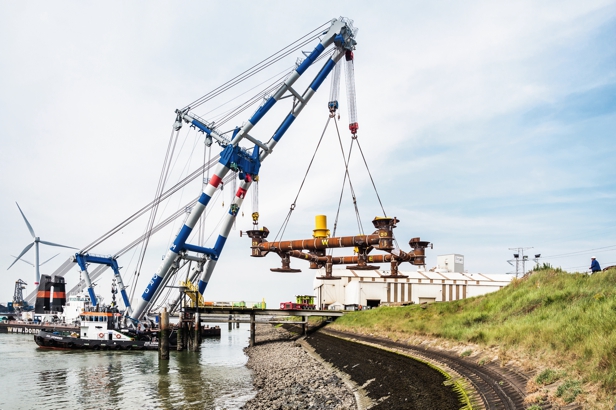
Offshore innovations
The offshore market is changing. Operations & Maintenance (O&M) is becoming a bigger factor within the sector and there are other developments also taking place. Engineering Procurement Construction (EPC) projects are on the rise. Before, the owner of a wind park often specified an installation, which was then prepared as a construction kit and built. Nowadays, initiators of wind parks often just buy the license. Then the project gets taken on by a main contractor and an installation contractor. One company delivers the complete foundation, another delivers a turbine, and then they require an EPC delivery. “We will not do serial foundation-building,” Mr Wattel emphasises. “What we can do, however, is everything around an installation. We provide the tools to build the windmills: pile grippers, handling tools, spreader bars, sea fastening scopes, installation tools, etc. The location in Vlissingen will be able to facilitate bigger ships. We’re on the water, so we can load those tools directly onto the barges. Our personnel are trained and ready. They’ve done projects like this before, as well as O&M projects. What might be more important however, is that the whole chain is always pressed for time and as we have such a large production capacity, we can shift quickly. We can mobilise a large crew for projects within a very small time frame. And we’re one of the few companies that can.”
