

In January of this year, BOW Terminal announced that Scottish Power Renewables had chosen the Zeeland company as marshalling yard for the East Anglia One offshore windfarm. Since the announcement, things have become quiet, and it looks as if nothing has been happening. But this is just a façade, as behind the scenes, the people at BOW are hard at work preparing for the start of this mega project.
A total of 14ha of Bow's terminal will be in use for East Anglia One.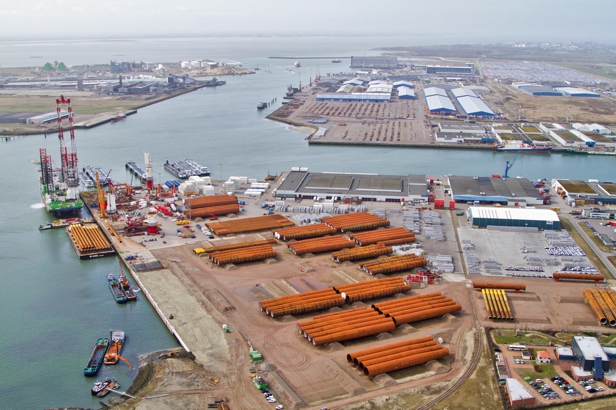
In the build-up to the Offshore Energy exhibition, where many Zeeland companies, including BOW Terminals, will be representing themselves, Zeeland PortNews talks with Ludolf Reijntjes, Manager Director of BOW Terminal.
“Indeed, a lot has happened since January,” Mr Reijntjes states. “A total of fourteen hectares will be in use for the project. Once it is in full swing, but before the arrival of the first pinpiles, we still have to finalise a lot of pre-work. The current dykes, for example, need to be replaced by new ones that are strong enough to bear the piles, and at other locations on the terminal, things are also being made ready for the arrival of the numerous components.”
An impressive sight
Within the next few months, 306 pinpiles will arrive at BOW Terminal’s quay in the Westhofhaven in the port of Vlissingen, along with 36 jackets. From that moment, BOW Terminal will need all hands on deck. Lamprell will be delivering a total of 180 pinpiles in three separate trips from China. A further 126 pinpiles will be shipped by Van Oord from the Spanish producer Windar. Of these piles, a maximum of 40 will be stored at the terminal as flexible stock due to in and outgoing shipments. Because these shipments will take place with geared-up vessels, no crane will be necessary for discharging. “For unloading the vessels we will make use of SPMT’s we rent from one of our suppliers,” Mr Reijntjes explains. The 36 tripod jackets will be produced by Lamprell at their facilities in the Middle East. As they will be shipped to Vlissingen on semi-submersible vessels and unloaded in a ro-ro operation, no cranes will be needed for this either. Once in Vlissingen, the jackets, each with a height of 70m, will be an impressive sight, visible from all over Zeeland. Apart from the pinpiles and jackets, grout, used for the foundations, will be stored in Vlissingen as well.
Proper planning
The materials arriving at the terminal will also have to leave it at a given moment. According to the plans, the outgoing operation will start in spring 2018 when the piles and jackets will be transported by installation vessels to their final destination. “One of the challenges will be when, at a certain stage, we have to take care of both the ingoing and the outgoing vessels,” Mr Reijntjes explains. “Proper planning will be of the essence. We are fortunate that, when necessary, we can make use of the quays in the Bijleveldhaven that are managed by our mother company, Kloosterboer. From there, we can easily transport the pinpiles to our terminal by SPMTs if the Westhofhaven quay is in use for other activities. It goes without saying that, although we do not carry the overall responsibility, we want to make sure that everything runs safely and smoothly in order to make the project successful.”
Mega project
Operations at the terminal will not be restricted to loading, discharging and storage activities. “On arrival, the jackets will not be completely finished and Lamprell has asked us to arrange for the final construction to take place at our terminal. Apart from this, the piles will also need final assembly and painting. This construction and paint work will result in around ten to twenty extra jobs,” Mr Reijntjes states. Furthermore, BOW will be in charge of all logistics operations. Mr Reijntjes explains: “For Scottish Power, it is good to have one company taking care of everything. This allows things to run efficiently and effectively. Apart from this, time and money will be saved as we are going to make use of the necessary equipment for both the Lamprell and the Van Oord operations.” A variety of companies with a wide range of interests means that a careful approach is necessary. Mr Reijntjes agrees: “No doubt, this mega project with so many different aspects and interests will give us some challenges every now and then. But as long as every person from every company involved in the project keeps the final goal in mind, I am convinced everything will work out fine.”
The jackets will be shipped to Vlissingen on semi-submersible vessels.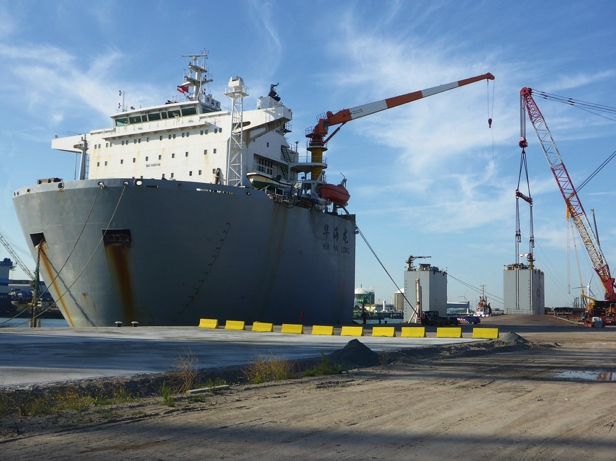
A lot of work
If everything goes according to plan, the East Anglia One project for BOW will end in autumn 2018, when all components will have left the port and life will return to normal. But there will be no room for complacency, as new projects will be waiting to make use of BOW’s facilities. “Working on the East Anglia project does not mean we are not looking ahead. Too bad that I can’t go into detail about new projects, but for BOW Terminal, offshore wind will remain an interesting industry for the next few years, resulting in a lot of work,” Mr Reijntjes concludes with a smile.
