

On Thursday 8 June the Bottom Ash Recycle (Back to the Future) Seminar was held in BioBase Terneuzen. The event was organised by Heros Sluiskil, in conjunction with the Confederation of European Waste-to-Energy Plants (CEWEP). It attracted 200 guests from many prominent organisations.
Heros handles 650,000t of bottom ash per year.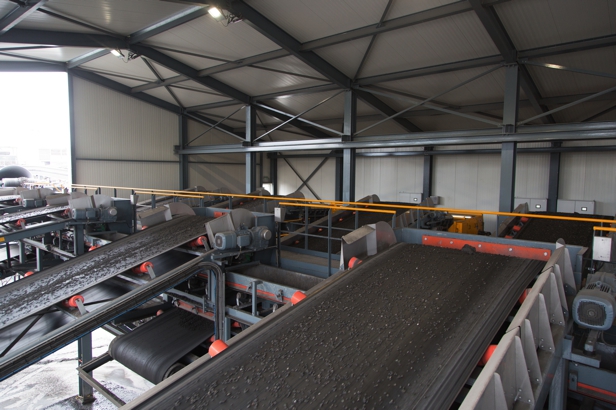
The seminar on ‘Bottom Ash Recycling – Building brick for the circular economy’, was led by Roelof Hemmen, Dutch newsreader and radio presenter. Participants included Pascal Peduzzi (Director of the Global Change & Vulnerability Unit at the United Nations Environment Programme (UNEP/GRID-Geneva)), Maxime Pernal (CEWP), Jose Jorge Diaz del Castillo (Legal Officer in DG environment, EU Commission), Marcel Bettonvil (Director MBI), Jurgen van Gorp (Business Development & Area Manager at Metallo Group) and Jos Brouwers (Professor TU Eindhoven). The well-attended Seminar underlines the Heros strategy of innovation and renewal, in line with a company culture of sustainability and respect for environmental and ‘Green Energy’ issues.
Company profile
Since its takeover five years ago by the German Remex Mineralstoff GmbH, Heros Sluiskil has concentrated efforts on improving and expanding operations, in line with the latest European rules and regulations. The 2012 acquisition provided Heros with welcome opportunities in the international market, as well as new impulses and funding to modernise and innovate its facilities. Today, the Sluiskil EcoPark occupies a 45ha plot, with plans to expand by an additional 7ha. Heros handles 650,000t of bottom ash per year, the equivalent of rubbish from six million Dutch and Belgian households, all arriving at the EcoPark by barge. Waste is first incinerated in waste-toenergy (WtE) plants in the Netherlands and Belgium, producing what is known as bottom ash. This ash is then sorted, the contents being separated with as much precision as possible for recycling as raw material for multiple applications. Transiting a modern production line, scrap material is the first component to be extracted from the bottom ash using magnets. After this the ash is sieved and sorted before entering the Eddy-Current machine where ferrous and non-ferrous materials are separated. The current machinery detects particles of 1mm diameter or larger, but the goal is to optimise this further to 0.5mm or larger. Chrome, copper, aluminium, nickel and zinc can now be extracted. In the future it will be possible to retrieve even the smallest amounts of gold and silver.
At the end of the process, a granulate is left that can be used in the building industry. This is known as IBC (isolate, manage, control). Prior to 2012 this material was largely used in roadconstruction works. In 2012, the Dutch Ministry of Infrastructure and the Environment issued legislation stating that the material must be encased to prevent any leaking into the environment and should be suitable for all building applications. This ‘Green Deal’ initiative required a 50% improvement in the quality of raw material produced by Heros by 2017, a target already achieved, with the 100% level to be reached by 2020. In response to these new regulations, Heros developed and implemented an improved process. This has resulted in a new, cleaner end product, known as granova combimix. This NV (not shaped) building material can be used in road construction with no need for additional insulation. Another of Heros’ products is granova granulate, a suitable alternative for sand and gravel in concrete and asphalt.
A look round EcoPark
Arie de Bode, Heros Director, is happy to give a tour of the Sluiskil EcoPark and describe the latest developments in more detail. In his office looking out over the Ghent-Terneuzen canal, he empties the contents of a canvas bag on to his desk. He never tires of showing a willing audience some of the surprising finds from our household rubbish. The miscellaneous pile includes an antique revolver, silver spoons, old coins, jewellery, mobile ‘phones. You name it, he has come across it! Driving round EcoPark, Mr De Bode points out the installations that have made innovation reality for Heros. The newly operational WtE bottom-ash process plant is an example. An additional step (known as an indirect cascade) has been incorporated in the process. This enables extraction of larger amounts of non-ferrous metals than previously. This material is further processed in a specially developed plant that was taken into operation on 1 June. The final, clean metals are supplied directly to smelting works, thereby guaranteeing recycling of these valuable materials. Heros is also constructing a bespoke washing installation. This will rinse the WtE bottom ash and wash out salts. It forms a vital part of the process. It will result in high-quality NV building material and ensure that the new granova combimix is approved for use in infrastructure projects. This exciting new installation will be operational in July this year.
Another point on the Heros agenda, is a plan to extend the EcoPark water-treatment plant with an extra, third ‘wash street’. Currently in the design phase, this facility will increase on-site water-processing capacity. A related project is the realisation of a water-chain cycle. This will enable rainwater and clean (waste) water to be recycled and reused multiple times as process water, before finally passing through the purification plant and entering the drainage system as clean water. We stop on the 500m quayside, with a water depth of 8m, where 100m is now equipped to receive tankers. Modern installations and pipelines have recently become operational, serving the Tank Terminal Sluiskil (TTS), also located on the EcoPark. TTS has a storage capacity of 50,000m3, divided over fourteen tanks with varying capacities. A total of EUR 20 million has been injected into these innovations and Mr De Bode proudly states that Heros Sluiskil has received no subsidies for this work. Profits from these improvements are already visible. One encouraging note is the agreement of an important contract for 2018, to supply 500,000t IBC-quality bottom ash to the Sloeweg road-construction activities. This is an important project for Zeeland, connecting the A58 motorway and the Westerschelde Tunnel and relieving some of the pressure on access routes to the Port of Vlissingen. Heros is also contributing to an identical road-construction project, currently underway at the Joure motorway junction in Friesland.
The future looks bright
The new WtE reprocessing plant, renewed washing installation, non-ferrous plant and TTS have now all been realised, providing an additional level of quality. The substantial outlay for these acquisitions has been a good investment and contributed to an improved circular economy. Heros has been at the forefront of the WtE bottom-ash processing industry for many years and, as a pioneer, has overcome some hurdles. Heros is constantly investigating opportunities to further streamline and improve processes and end products. As an example, three Post-Doctorate students from the Dutch Technical University (TU) Eindhoven are currently working on a project on the use of bottom ash in several new applications. As Mr De Bode says – and the Back to the Future Seminar clearly showed – urban mining is now real precision work. The ultimate aim is to let nothing go to waste. Making the process even more efficient and accurate is a win-win situation, for Heros and the environment. With Remex Mineralstoff GmbH as a strong parent company, Heros is an expanding business, with many opportunities for further growth.
Mr de Bode, Director at Heros.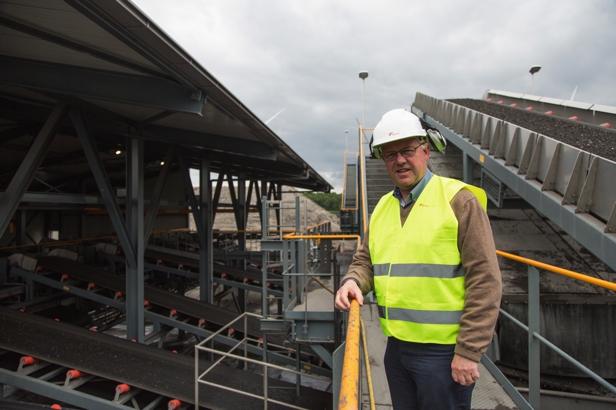
Facts and figures
The origins of Heros can be found in Roosendaal. A familyowned company, it was set up to treat bottom ash from AVR Duiven (at that time Avira) for use in the construction of roads. In time the company outgrew its Roosendaal location and in 2000 activities were moved to a 45ha terrain in Sluiskil, previously occupied by the AZC cokes factory. This plot became known as EcoPark Terneuzen. In 2012 Heros was acquired by Remex Mineralstoff GmbH, part of the Remondis concern which employs around 25,000 staff and is operational in approximately sixty countries. Its location directly on the Ghent-Terneuzen canal provides easy access to important European waterways and all goods are transported by water. Over a period of twelve months, Heros can expect a total 2 mtons of products to pass the quayside. Heros obtains around 20% of its energy from wind energy, with this amount increasing each year. Heros Sluiskil employs ninety permanent staff, with the total expected to increase to around one hundred in the near future. The Management Team consists of Arie de Bode, Jan Kappetein and Erwin Pieters. The Terneuzen EcoPark also houses the Tank Terminal Sluiskil (a joint venture with ATM Moerdijk and ESE Oostburg) and Neste’s Biodiesel Plant.
