

At the recent Zeeland Port Congress, organised by Zeeland Seaports, the main topic was Blue Growth. Speakers and participants discussed the many initiatives in and around the Zeeland port area that show that the ports of Vlissingen and Terneuzen are already ahead when it comes to sustainability.
Glastuinbouw Zeeuws-Vlaanderen uses CO2 and residual heat from its neighbour Yara Sluiskil.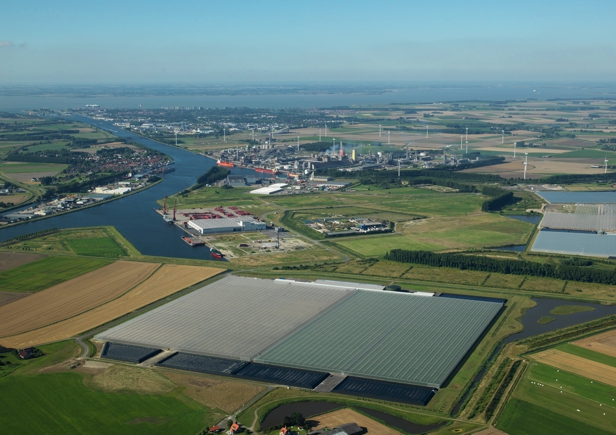
Taking up the topic of the congress, Zeeland PortNews looks into this new phenomenon. What exactly is Blue Growth? What is happening within Zeeland in this field? What efforts are being made by Zeeland Seaports and why did sustainability become such a strong proposition for the Zeeland ports?
Blue growth strategy
‘The blue economy can be a driver for Europe’s welfare and prosperity’. That was the message of the Blue Growth strategy adopted by the European Commission in 2012. Blue Growth is the long-term strategy designed to support sustainable growth in the marine and maritime sectors (the ‘Blue Economy’) as a whole. Seas and oceans are the drivers of the European economy in many sectors where there is great potential for innovation and growth. Blue Growth can be seen as the maritime contribution to achieving the goals of the Europe 2020 strategy for smart, sustainable and inclusive growth. Zeeland Seaports, the Port Company as well as the companies working in and around the port area, have already been showing proof of this for many years.
Spearhead
In its most recent business strategy ‘Winning Combinations’, Port Company Zeeland Seaports considers sustainability as one of its spearheads. For the Port Company, this is not just lip-service in the form of a popular written phrase, as a lot of environmental projects have already been realised in the port area. This way, Zeeland Seaports is contributing to the Blue Growth goals in a very practical and direct manner. The development of the Zeeland port area goes hand-in-hand with sustainable nature and quality of life. Zeeland Seaports considers sustainability to be important for the continuity and competitive power of the ports of Vlissingen and Terneuzen. In ‘Winning Combinations’, three sustainable tracks are defined:
- Track 1: sustainable spatial planning of the port area and sustainable operation of the Port Company.
- Track 2: regional and supply-chain agreements with industry, government and social stakeholders in order to realise cohesion between sustainable and economic developments.
- Track 3: attracting new companies to invest and settle in the Zeeland port area that contribute to the circular economy, transition of energy and raw materials, and industrial symbiosis.
A number of activities are described within these three tracks:
- Zeeland Seaports achieves the environmental accreditation Ecoports by 2019 latest.
- In collaboration with businesses, governments, and environmental associations, Zeeland Seaports’ environmental and economic objectives in the Terneuzen and Vlissingen port area are determined.
- CO2 emissions reduction will be realised through a sustainable modal split.
- A maximum of 20% of goods arriving at the ports through inland shipping will leave the port via road transport. This reduction of road transport will be achieved through supporting the realisation of a minimum of five additional
pipelines and a strong commitment to the construction of additional rail connections. - Extra focus will be given to the efficient use of land, the restoration of the estuarine dynamics and biodiversity in the Western Scheldt River as well as the increase of bio-based production.
Written statement
This sustainability agenda is, in fact, a written statement of what has already been going on in the ports for years. It is a promise that the Port Company will continue its own sustainable activities and will keep on supporting initiatives from third parties that are involved in the port. The road to becoming a sustainable port already started more than a decade ago, when Zeeland Seaports was one of the founding partners of Biopark Terneuzen. Biopark Terneuzen is a concept in which companies share each other’s residual materials. The best example of this is the greenhouse project Glastuinbouw Zeeuws-Vlaanderen. This 300ha greenhouse complex uses CO2 and residual heat from its neighbour Yara Sluiskil. This way, Yara can reduce its CO2 footprint and the greenhouse farmers reduce their use of fossil fuels to zero. The CO2 and residual heat is transported by underground pipelines, managed by WarmCO2. WarmCO2 is now one of the leading experts in this field and has been invited by many other companies to help in the realisation of the same kind of interchange.
Sloewarmte
In Vlissingen too, this kind of interchange is taking place. Over here, a number of companies are cooperating under the project name of Sloewarmte to pioneer an initiative in which they make use of each other’s residual heat. The residual heat coupling takes place between Zeeland Refinery, Martens Harbour Reception Installation and COVRA. Waste-heat from Zeeland Refinery production is captured at 140°C and delivered as water via a pipeline to Martens and COVRA. Martens uses the waste-heat to purify used oil from (maritime) vessels and make it suitable for reuse. COVRA converts the residual heat for the climate conditioning of their offices. After use, the water goes back to Zeeland Refinery, which in turn re-uses it as cooling water in its production process. On an annual basis, this coupling leads to a saving equivalent to the energy consumption of approximately 1,500 households. The process also lowers CO2 emissions by about 4,300 tons per year.
Solar Park and Wind Energy
In and around the port area, Zeeland Seaports promotes and supports initiatives to make use of solar and wind energy. Solarpark Scaldia is a 40ha solarpark that will be constructed in the Vlissingen port area, in the cable and pipeline corridor. In order to finalise the project, the park has been granted an Incentive Grant for Sustainable Energy (SDE) subsidy from the Government. The solar panels will be placed east to west instead of facing south. This is an innovative way of being able to place more solar panels per hectare and not overproducing energy in the peak hours. The hope is that the solar park will attract new companies to the port, as an increasing number of companies want to use sustainable power generated on-site. Ultimately, the park could also benefit the residents of Vlissingen. Furthermore, numerous wind turbines supply power both to the national grid and to a great number of companies in the port area.
Shore Power
Zeeland Seaports is promoting inland shipping as a sustainable modality. To this end, the Port Company is taking steps to make the port more attractive to inland shipping. One of the initiatives is the installation of a large number of shore-based power facilities. With these facilities, barges can make use of electricity from the network instead of using their own, more polluting, diesel generators. The use of shore power reduces NOx and particulate matter emissions and also lowers noise pollution. Research is being carried out into the effects of shore power. Results indicate that shore-power supply boxes in and near to residential areas have a positive effect on the environment. This is the reason why the first extension of shore power took place in urban areas such as Terneuzen, Sluiskil and Sas van Gent.
The ecological management of the vegatation in the port area maintains and improves biodiversity in the region.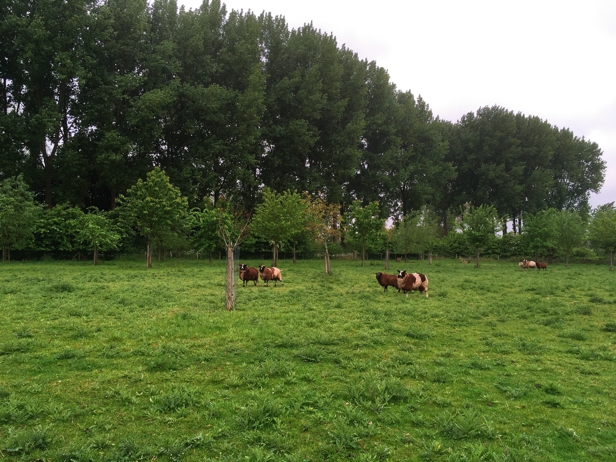
Nature Management
The ecological management of the vegetation in the port area is a way of trying to maintain and improve biodiversity in the region. Zeeland Seaports’ policies are geared towards trying to accommodate as many different types of plants and animals as possible, wherever possible. Zeeland Seaports value the preservation of nature and the environment. They do this on the one hand by exploring/testing the results of the (proposed) activities for the spatial complexity of Natura 2000 and the main ecological structure areas surrounding our management area; on the other, they try to maintain the diversity of flora and fauna right up to the moment that a company opens its doors in that area. In other words, fallow land remains that way until its required for other purposes. The Port Company also tries to maintain the flora and fauna, and where possible improve it, in areas which cannot be used by companies (verges, dykes, power lines, etc.). The ecological management of the natural environment for the port of Vlissingen was set down in a plan in 2010, and was then executed. The plan for Terneuzen was completed in 2013 and ecological management has been launched in a number of places.
