

At the Autrichehaven in the port of Terneuzen a giant silo is under construction. Though it is not yet complete, the massive structure is already strikingly eye-catching within the port area. But the view will soon change, as a second, smaller silo is scheduled for completion in a few months’ time. Although the dimensions are impressive,” Mr Paul Van den Broeck, CEO of Zeeland Sugar Terminal explains, “the silos are in fact nothing more than the sugar cup you have at home; but still, they are a bit bigger.”
Zeeland PortNews talks with Mr Van den Broeck about the new sugar terminal that will be operational in Q3-2017, right before the start of the European sugar season.
A 80,000t sugar cup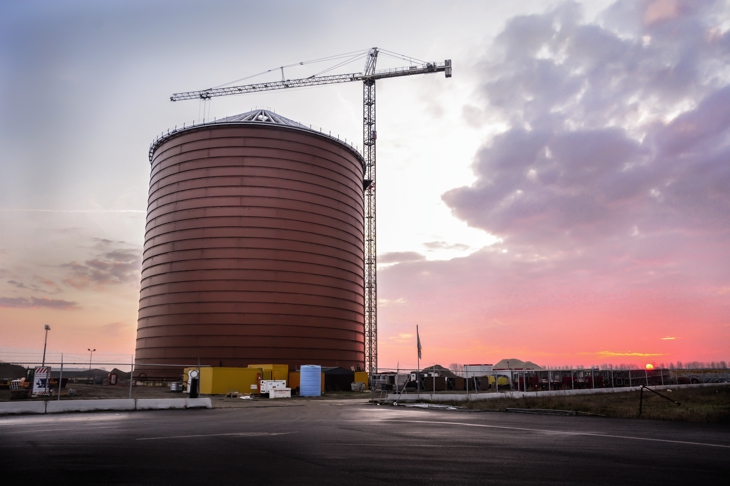
An Educated Decision
The story of the Zeeland Sugar Terminal began a few years ago when Vlaeynatie, the company behind the terminal, decided to build a new terminal for fertilisers at the Autrichehaven. “Vlaeynatie already has two fertiliser terminals in Spain (Cadiz and Castellon), but in response to demand from our loyal long-term customers, we were looking for a third location in the North-West part of Europe. When Zeeland Seaports highlighted the potential of the Autrichehaven we were very enthusiastic. The location is ideal with a quay to accommodate vessels with a draught up to 12m, at close range from the North Sea and with excellent multimodal hinterland connections. Additionally, both Zeeland Seaports and the Terneuzen authorities were highly cooperative in helping us to realise our plans. A large piece of land adjacent to the fertiliser terminal was also available, so when we had plans to launch a business in sugar, the decision to choose Terneuzen was easy.”
Growing interest in sugar
As from 2017 the European sugar market is deregulated and, according to experts, the export of European white beet sugar will rise due to growing demand. “Although the consumption of sugar in Europe is stabilising, the worldwide market still offers great potential, especially in North Africa, the Middle East and the Far East,” Mr Van den Broeck explains. “Countries such as China and India show a growing interest in European white beet sugar, which compensates for the European market situation.
In addition, significantly improved agricultural techniques will result in higher yields and a more competitive price for beet sugar.” The new sugar terminal sees Vlaeynatie returning to their roots. Mr Van den Broeck comments: “We started handling sugar in Antwerp in 1985, but in 2009 we decided to end our collaboration with Babcock & Brown and to withdraw from the sugar business. However, we kept our eyes and ears open; because of changing European regulations in 2017, the sugar market will be in full motion, creating new opportunities. After several conversations with specialists that we have known for years, and with all facts and figures considered, we have decided to return to the sugar industry. Things look very promising; as of now we have attracted sugar plants from Belgium, France and Germany to handle and store their sugar. All sugar we handle is type EC cat. 2 – the same sugar we have at home.”
Railway connection
The sugar will be transported from sugar plants to the terminal mainly by truck, but a rail connection will also be realised. Before transportation to overseas markets, the majority of the sugar will be packed in 50kg bags or bigger, with the remainder stuffed directly into containers with inliners. “Of course, it would be great to have a direct container service from Zeeland,” states Mr Van den Broeck, “but at present it is our customers’ choice as to which shipping company they book their containers with, and to which deepsea terminal we have to transfer them to. At the site two silos are under construction. One will have a capacity of 80,000t (80 million packs of sugar!) and the second will be able to contain a maximum volume of 50,000t. Zeeland Sugar Terminal will have a storage capacity of 130,000t with the expectation for a larger throughput. There is also room for further silos to be constructed in future. “First we want to see what the market is going to do before we decide on building extra silos,” says Mr Van den Broeck of the future. “Currently, the sugar for overseas markets is non-traceable, meaning sugar from different suppliers can be mixed in one silo. But should this change and buyers demand traceable sugar, we should review and adapt our plans to our customers’ needs.”
Container facility
The future for Vlaeynatie in Zeeland looks bright. The fertiliser terminal is up and running and plans are underway to build new warehouse facilities for fertiliser in a nearby area. The fertilisers from Chili are partly processed by Plantacote, a subsidiary of SQM, which has a facility on the Vlaeynatie terminal. At Plantacote, the fertilisers are upgraded on customer request. The remaining volume of imported fertilisers are stored in bulk, and after that packed in bags. The newly built warehouse will allow for expanded bulk storage facilities increasing from 15.000m2 to 25.000m2. But there is more, and Mr Van Den Broeck raises the corner of the veil: “There is growing demand from our customers for containerised transport of fertilisers and sugar. Therefore, it would be very convenient to have our own container facility. We recently signed an MOU with Zeeland Seaports to lease a piece of quayside land next to our sugar terminal where we are going to have a container terminal. This terminal, which we hope will become operational in 2018, will also be used by our logistic partners for other parties.”
Mr Van den Broeck, CEO at Zeeland Sugar Terminal and Vlaeynatie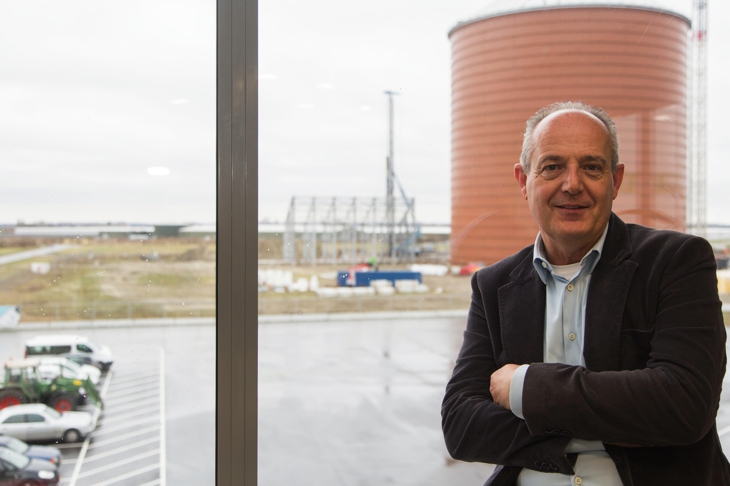
Part of a team
Vlaeynatie is currently recruiting to keep up with the growth of its developments. The current staff of 31 needs to grow to around 60, not including a fl exible workforce required for seasonal projects. Mr Van den Broeck explains: “Sugar is different compared to working with fertilisers, as the regulations for hygiene are much stricter and no hands are allowed to come into contact with the product. Therefore, sugar is transported and packed using automated machinery. The process is 100% HACCP.” Still, for work at both the fertiliser and the sugar terminal the human factor is considered to be crucial at Vlaeynatie. “Here at the Autrichehaven we work as a team, making no distinction between the two terminals. We are, and act, as one organisation constantly looking for synergy. Everyone is able to work with both commodities,” Mr Van den Broeck says. “And with regards to the construction of the facilities, our suppliers, most of whom are from Zeeland, truly form part of the team. We really need each other to get everything right.”
