

Ovet dry bulk terminal has been in business since 1957 and is celebrating its 60-year anniversary this year. With the market shares in the coal industry at an all-time low due to the legislation surrounding CO2 emissions reduction, the company is having to make changes in order to keep business healthy and thriving. At the helm in these times of tumult is the innovative and experienced ‘coal man’, Vincent Courtois.
Unloading of bigbags at Ovet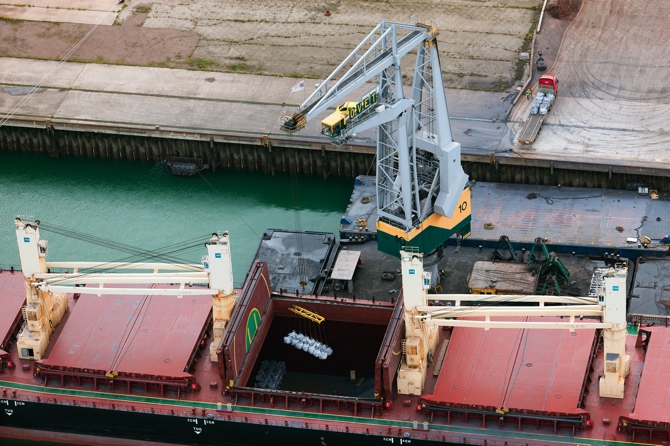
Ovet specialises in storing, transshipping and processing dry bulk goods. Their four floating cranes ensure a total discharging capacity of as much as 80,000 tons but the tides are turning. Vincent Courtois explains: “Recently there have been quite some closures with regard to steel production sites. Wallonia, Belgium has had its fair share and further along in the Lorraine region of France, a major steel production company has had to shut down as well. No coals are used at all anymore in Belgium for the production of electricity and in the Netherlands we are also seeing a big reduction. The coal plant at Borssele has closed due to the environmental agreement and aluminum company Zalco in Vlissingen has gone bankrupt as well.”
Threats
Ovet sees about 8 to 9 million tons of incoming and outgoing activity per year. Mr Courtois: “That is still quite a lot of business but we have to work hard for it. The coal industry is under pressure in North-West Europe. The production of steel in Europe has a major competitor on the rise: steel production in China. So we need to look for alternatives and find an answer to the question: How will we handle these threats to our business?”
Diversification
In order to keep going and growing, Mr Courtois is restructuring the business from a company that focuses solely on solid fuels to a multifunctional stevedoring concern. He is basing this reconstruction first of all on diversification, from solid bulk to agri-bulk, mineral bulk and biofuels. This change sees the need for covered storage space. In Vlissingen the company has a 6,000m2 warehouse at its disposal and by the end of this year, another warehouse will be added that will provide Ovet with a further 10,000m2 of covered storage space. Their second pillar of innovation focuses on breakbulk. Mr Courtois highlights, “The breakbulk market is large, and varies from big bags to project cargo. Our floating cranes can be used for other markets as well, so we do have potential for expansion there. That is why we will be present at the Breakbulk Expo in Antwerp. We’d like to meet with other companies, create new relationships and invest in synergies.”
Added Value
French stevedoring company Manufrance originally established the transshipping company in 1957 for a major customer: the Association Cooperative Zélandaise de Carbonisation, also known as the Cokesfabriek (Coke factory), as they focused mainly on the production of cokes for the blast furnaces of French steelworks. Terneuzen was a favourable location, because it is well-situated with regard to England and the Ruhr area, which is where the coals came from. Later on, the company added a dry bulk location in Vlissingen. The deep waterway in the two ports was a major advantage, as was the company’s willingness to explore other options, such as added value opportunities. “The deep waterway remains a key benefit today,” explains Mr Courtois: “It ensures that we have an ideal location for transshipment. We decided to expand our services and create added value years ago by allowing our clientele to create partnerships and collaborate with us. Together we formed stronger entities. Our experience with added value gives us an advantage within the breakbulk sector as well. We can use this competence with other kinds of freight traffic. For example, more and more freight will be containerised in the future, with incoming containers needing to be reversed back into breakbulk.”
Ovet Terminal - Kaloothaven in the port of Vlissingen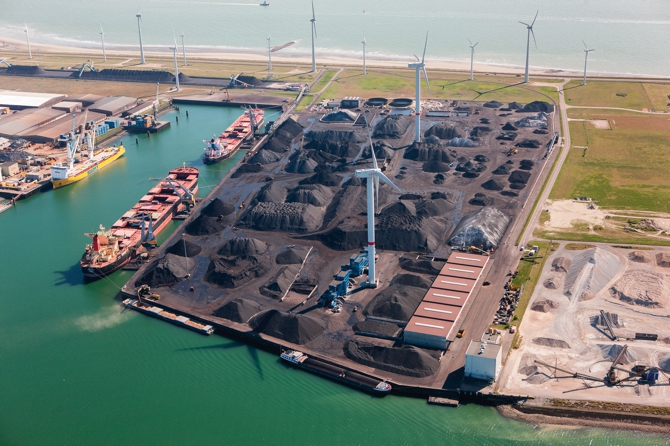
Bright Future
Ovet has turned a corner and has a solid vision for the future. Though they will never neglect their existing clients, they do want to look for collaborations with other companies in the harbour and remain open to embracing alternative paths. “By working together, we will find solutions,” clarifies Mr Courtois: “As we slowly move away from the familiar structures and adjust our company‘s DNA and evolve, our expectations are positive and we remain optimistic.”
